

Chatham Baroque brings 17th century to Upper St. Clair
Laila Archuleta
Laila Archuleta
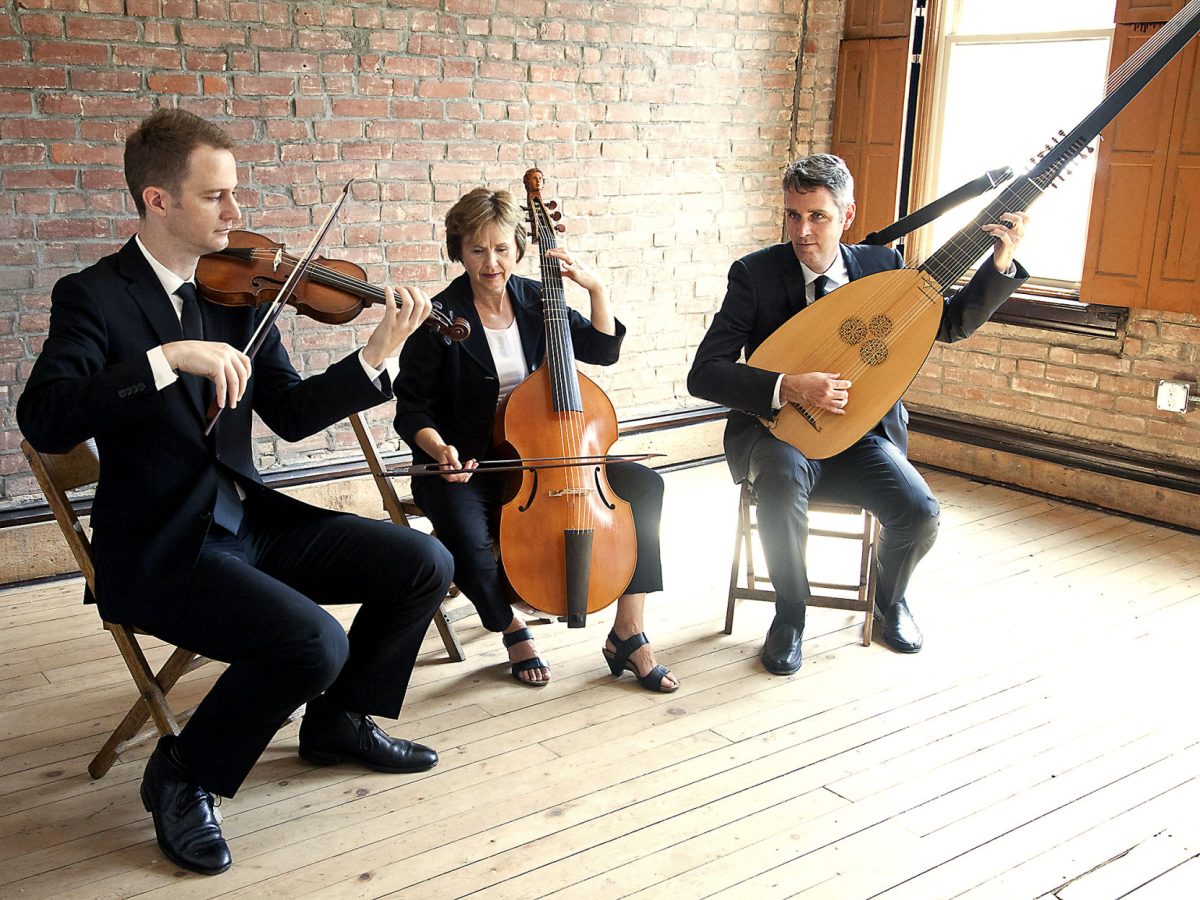
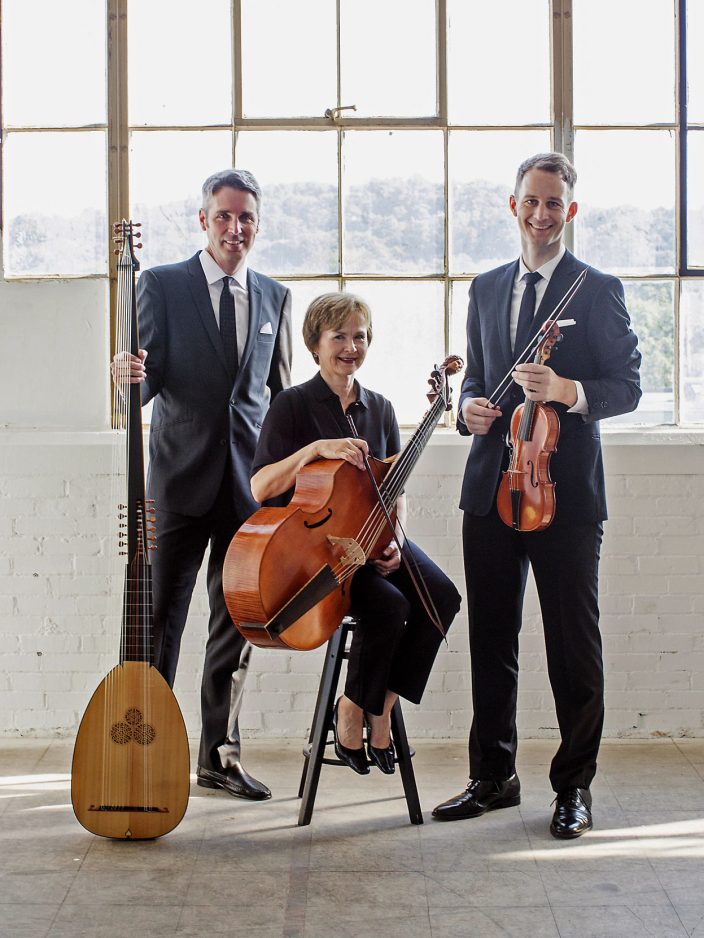
From left are Scott Pauley, Patricia Halverson and Andrew Fouts. (Photo by Laila Archuleta)
If you’ve ever wanted to see a theorbist in action, the opportunity is coming soon.
Of course, unless you’re a scholar of early music, your reaction is going to be: Huh?
A theorbist – in this case, Scott Pauley – is a person who plays the theorbo. And because that’s probably also a new one on you, let’s describe it as a long-necked lute that’s kind of a 17th-century cross between an acoustic and bass guitar.
Pauley will show how it works when he joins fellow musicians Patricia Halverson and Andrew Fouts in an “Art of the Trio” performance by Chatham Baroque at 7:30 p.m. Nov. 10 at Westminster Presbyterian Church in Upper St. Clair.
Their instruments may be more familiar to 21st-century audiences, but the instruments of Halverson and Fouts differ subtly from their musical descendants. Hers is the viola da gamba – that’s “viol for the leg” in Italian – which, indeed, she plays upright, positioned between her knees. Fouts plays the baroque violin.
“Baroque violin playing is its own thing,” Fouts said, comparing it with modern bluegrass or folk, “and a lot of its distinction is based upon the way that it’s set up: no shoulder rest, no chin rest. It just rests on my collarbone. The string tension is lower, so it doesn’t project in the same way. It has a somewhat more relaxed sound.”
The Trio show – featuring “their most adventurous and virtuosic music, tight ensemble playing and mischievous sense of fun,” according to promotional materials – helps celebrate the 10th-anniversary season of Chatham Baroque’s current configuration. Halverson is a founding member, along with recorder player Jeffrey Stock and the late violinist Emily Davidson, in 1990.
“The personnel with both musicians and staff has changed over these 27 years,” Halverson said, “but we’ve been able to carve out a niche in presenting music primarily of the 17th and 18th centuries in various venues around Pittsburgh.”
One of them is Westminster Church, where Chatham Baroque first played in 2012, joined by local soprano Sara Botkin.
“It became known to me that they were interested in a South Hills presence,” church music director Christine Hestwood said. “We have a beautiful space to offer them, and we have really enthusiastic crowds for our own music and arts series. So it was a win-win for us, because we want to be a destination for great music in the South Hills.”
The musicians enjoy performing in the church’s original sanctuary.
“It’s a very small venue, and the audience is quite close to us, so we always hear that audience members can really both hear and see the connection between performing musicians, whether it’s just the three of us or if we have a couple of guests joining us,” Halverson explained. “The more intimate concert space makes the music all the more exciting and interesting.”
One of the more interesting aspects of baroque music is the room for improvisation by way of ornamentation, such as adding notes to embellish certain passages.
“There are dozens of different types of ornaments, and you can read about them in old books of treatises about what to do in certain situations,” Pauley said. “It’s a little bit like what a jazz guitarist or pianist would do. They have kind of a standard language they’re using, but then they’re kind of putting their own little stamp on it.
“So we try to go back and discover what that language was,” he continued. “We don’t fully know how people played back then, but there’s a lot we can learn from all these old sources.”
For more information, visit www.chathambaroque.org.
Andrew Fouts, Chatham Baroque artistic director and baroque violin, joined the ensemble in 2008. That year, he won first prize at the American Bach Soloists’ International Baroque Violin Competition. In addition to Chatham Baroque, he regularly appears with the Four Nations Ensemble and Apollo’s Fire, and since 2010, he has served as concertmaster with the Washington Bach Consort. His principal teachers include Charles Castleman at the Eastman School of Music and Stanley Ritchie at Indiana University Jacobs School of Music.
Patricia Halverson, founding member and viola da gamba, holds a doctoral degree in early music performance practice from Stanford University. Recent collaborations outside of Chatham Baroque include concerts with Ensemble VIII, the Rose Ensemble, Empire Viols, Mountainside Baroque, J. S. Bach’s Brandenburg Sixth Concerto with the Pittsburgh Symphony Orchestra, and Bach passion performances with the Buffalo Philharmonic and PSO. She has served on the faculty of the Viola da Gamba Society of America’s annual summer conclave and teaches gamba privately in Pittsburgh.
Scott Pauley, theorbo, holds a doctoral degree in early music performance practice from Stanford University. Before settling in Pittsburgh in 1996 to join Chatham Baroque, he lived in London for five years, where he studied at the Guildhall School of Music and Drama. He won prizes at the 1996 Early Music Festival Van Vlaanderen in Belgium and at the 1994 Van Wassenaer Competition in the Netherlands. Pauley has performed with Tempesta di Mare, Musica Angelica, Opera Lafayette, Folger Consort, Four Nations Ensemble, Toronto Consort and Atlanta Symphony Orchestra.